Most people judge their diet by the number on the scales. A study published in the journal Radiology in 2026 suggests the scales can miss something that shows up clearly on a scan. Researchers at the University of California, San Francisco looked at thigh muscle composition in 615 adults and found that the more ultra-processed food a person reported eating, the more fat had accumulated inside the muscle itself, and that association survived adjustment for total calorie intake, fat intake, physical activity and sociodemographic factors.
That last point is the interesting part, and it is the reason this research sits awkwardly alongside the usual advice to eat less and move more. It does not overturn what we know about energy balance, and anyone reading our explainer on how a calorie deficit works for sustainable weight management should keep that intact. What it adds is a second question worth asking about a shopping basket, alongside how much, which is what kind.
What the Radiology study actually measured
The study, led by Dr Zehra Akkaya of UCSF's Department of Radiology and Biomedical Imaging, used non-contrast MRI to measure fat within the thigh muscles of 615 adults with no imaging signs of knee osteoarthritis. Diet was assessed over the previous year. Around 41% of the food participants ate was classified as ultra-processed, and higher intake tracked with more intramuscular fat.
The participants came from the Osteoarthritis Initiative, a research programme sponsored by the National Institutes of Health that follows how knee osteoarthritis develops. There were 275 men and 340 women, the average age was 60, and the average body mass index was 27, which places the typical participant in the overweight range. Akkaya's team describe the work as the first to assess ultra-processed food intake against thigh muscle composition using MRI.
Two limitations deserve to sit in plain view. Diet was self-reported over a year, which is a blunt instrument. And the design is cross-sectional in nature: it reports an association at a point in time, so it cannot show that eating this way caused the fat to appear.
Why fat inside thigh muscle matters for a knee
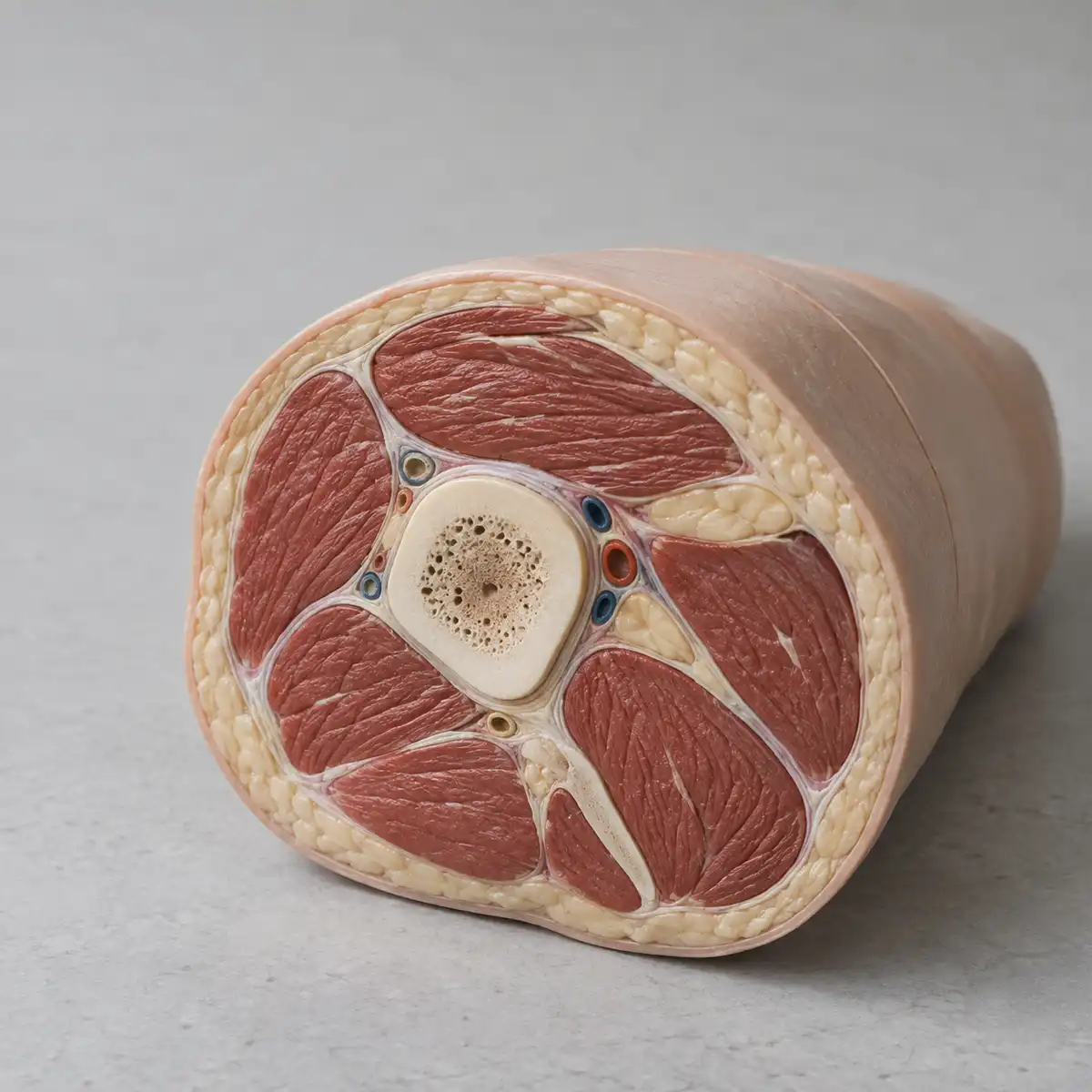
On an MRI scan, healthy muscle reads as fairly uniform tissue. What the researchers describe instead is fatty degeneration, with streaks of fat appearing within the muscle rather than around it. Nothing about that process announces itself. It is not visible in the mirror, and body weight can stay flat while it happens.
The quadriceps and the surrounding thigh muscles do the work of supporting and stabilising the knee. If the tissue doing that job becomes less muscle and more fat, the reasoning in the study is that its supportive function may weaken, which in turn changes the mechanical load the joint takes. Higher intramuscular fat has been linked to greater risk of developing knee osteoarthritis.
The authors are careful here, and so should we be. Their paper reports a relationship between diet and muscle composition. It does not establish that ultra-processed food damages muscle tissue, and it does not show that avoiding these products prevents osteoarthritis. The researchers state directly that further work is needed to confirm the mechanism.
The assumption this research puts under pressure
The belief worth testing is the familiar one that a calorie is a calorie, so the only thing that matters nutritionally is the total. Most weight guidance is built on that foundation, and for body weight it holds up reasonably well.
What the Radiology data complicate is the idea that total intake explains everything about muscle quality. When the researchers controlled for calories, fat intake and activity, the association between ultra-processed intake and muscle fat did not disappear. Akkaya's framing is that weight-loss regimens should take diet quality into account, not calorie restriction and exercise alone.
That is a modest claim, and it should be read modestly. One study on 615 mostly overweight 60-year-olds is not a rule for the whole population. It is a reason to treat food quality as a measurable thing rather than a matter of taste.
Recognising the categories in a UK supermarket
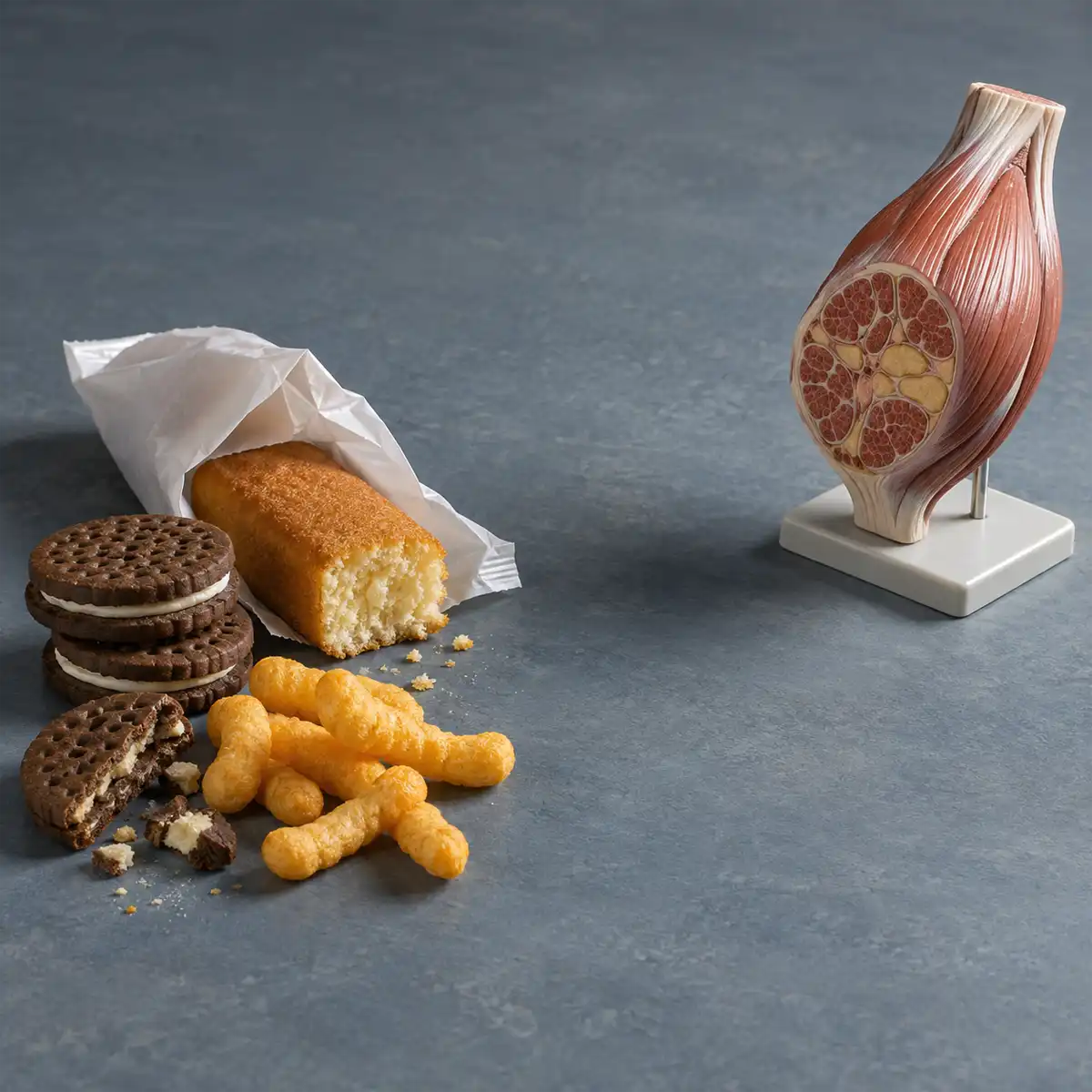
The classification used in the study is broad, and the specific product groups named by the researchers are easy to map onto a British weekly shop:
Breakfast cereals, particularly the sweetened ones
Margarines and spreads
Packaged snacks, sweets and desserts
Hot dogs and similar processed meat products
Soft drinks and energy drinks
Frozen pizza and ready-to-eat meals
Mass-produced packaged bread and buns
Worth knowing: the researchers note that these products typically combine sugar, fat, salt and carbohydrate in ways that stimulate the brain's reward system, which can make them difficult to stop eating, and that they usually contain synthesised ingredients. That is a description of how they are engineered, not a verdict on any single item.
Category alone is not the whole picture. Clinical dietitians Munawar Yahaya and Raghda Ali, quoted by Gulf News, point out that some products in these groups carry real nutritional value, citing fortified breakfast cereals and fortified plant-based milks, while sugary drinks and processed meats tend to be the ones high in added sugar, salt or less favourable fats. Their practical advice is to read the label, prioritise minimally processed foods, and treat sugary drinks and processed meats as the first thing to cut back.

Who this applies to, and who it does not
The findings describe a specific group: adults averaging 60 years old, typically overweight, enrolled because they are being studied for knee osteoarthritis, and with no imaging signs of the condition yet. The evidence does not extend to children, to young athletes, to people of healthy weight, or to anyone whose joints are already affected. Those populations were not measured.
Nor does the study set a threshold. There is no figure in it for a safe daily amount of ultra-processed food, and none should be inferred from the 41% average, which describes what these participants happened to eat rather than a limit. If you have diagnosed osteoarthritis, joint pain, or a condition that affects how you eat, a GP or a registered dietitian is the right place to take those questions, not a research summary.
What to do with this in a practical week
The useful takeaway is a shift in attention rather than a new set of restrictions. Cooking more from minimally processed ingredients, shifting sugary drinks and processed meats out of the regular rotation, and keeping resistance work in the week for leg strength are all defensible on existing grounds, regardless of what this particular MRI study eventually turns out to mean. Readers already working on other dietary changes, such as the foods that help lower high blood pressure, will find the same ingredients doing double duty, and the same is true of the everyday habits behind steadier energy levels without caffeine. For joint pain, mobility problems or any diagnosed condition, ask your GP for a referral to a registered dietitian or physiotherapist.