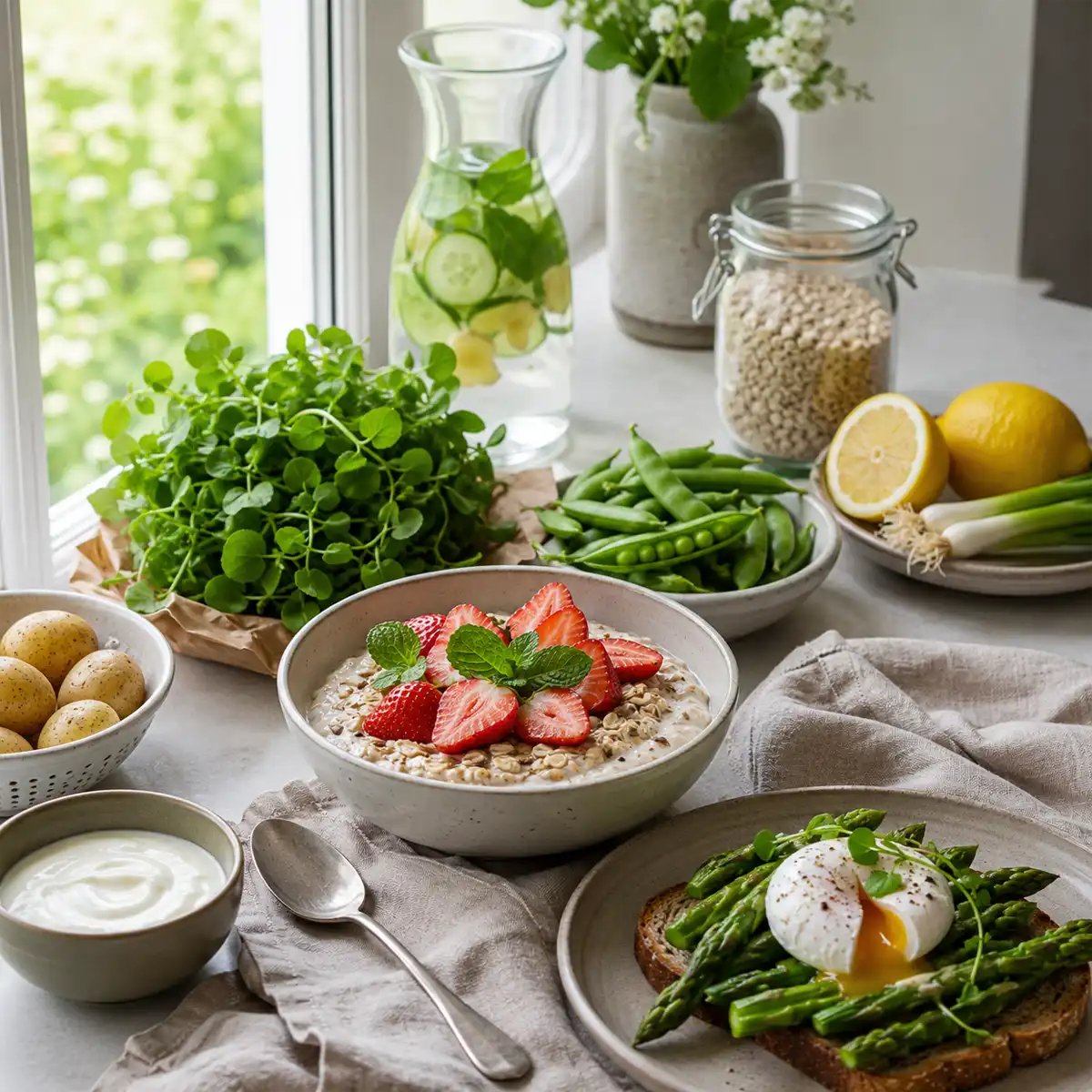
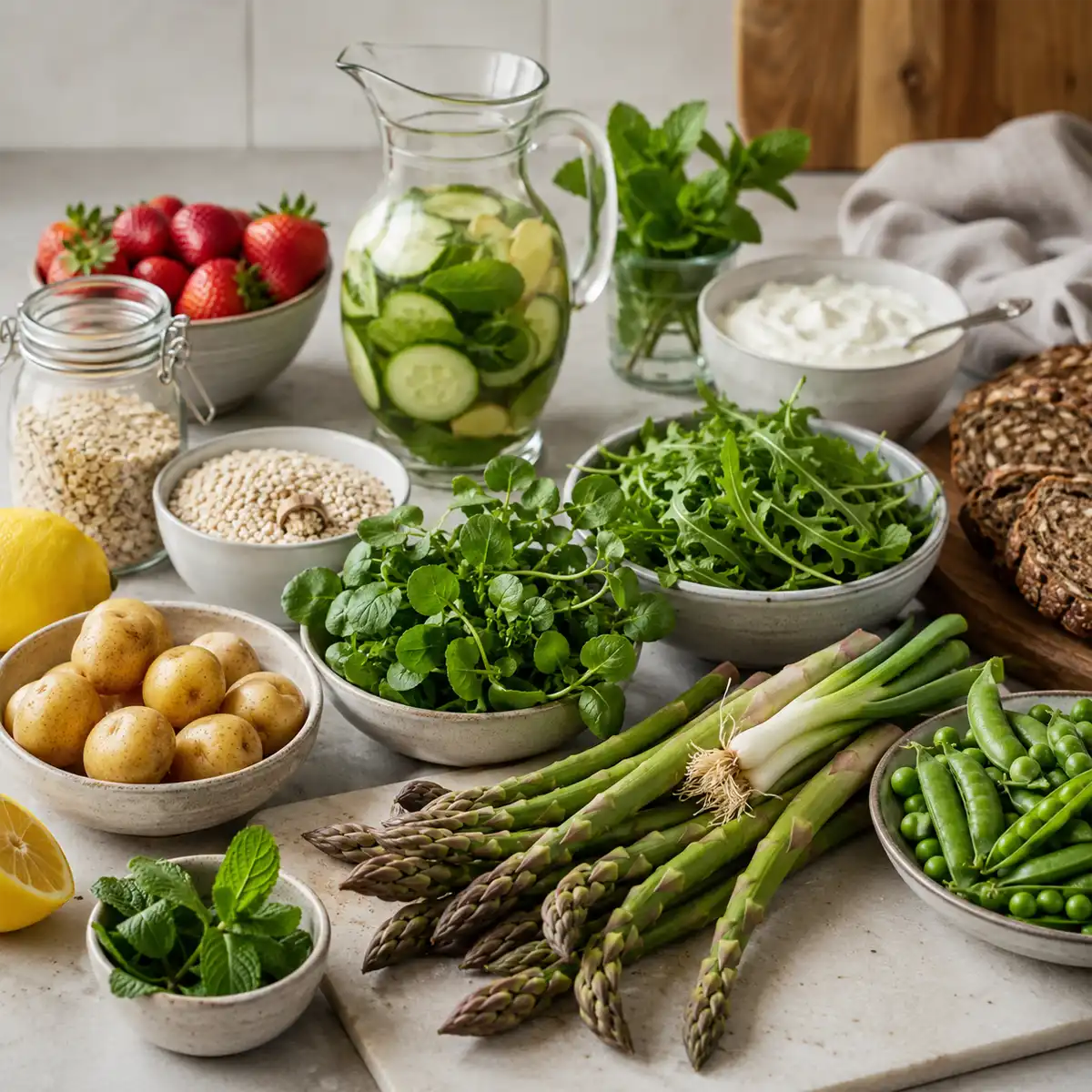
The first bundle of British asparagus appears on the greengrocer's shelf some time in late April, and the whole rhythm of the kitchen shifts with it. Jersey Royals, peppery watercress, rocket that actually tastes of pepper rather than nothing much, bright green peas straight from the pod, spring onions with their roots still on. After months of roasting roots and leaning on the freezer, the fridge suddenly wants to be full of things that taste alive. These spring detox recipes UK cooks will actually make are built around that shift, not around anything you have to buy from a health food shop.
The honest framing first. Detox, in the food-first sense the British Dietetic Association supports, means eating in a way that lets the liver, kidneys, and gut do what they already do, well. Your liver runs phase I and phase II detoxification pathways continuously. What spring eating can do is reduce the load. Less takeaway, fewer ultra-processed snacks, more plants on the plate, and produce at its seasonal peak when the polyphenol content tends to run highest. NHS Eatwell guidance updated in 2024 continues to anchor this approach. Five recipes follow, each with prep time, cook time, yield, and the nutritional reason it earns its place on the plate.
Before you make significant changes to your diet, speak to your GP or a registered dietitian, particularly if you are pregnant, breastfeeding, taking prescription medication, or managing a long-term condition. Seasonal eating should feel like a pleasure, not a protocol.
What spring produce brings to a gentle detox pattern
Spring produce is higher in young leafy polyphenols, bright bitter notes, and quick-cooking vegetables that do not need an hour in the oven. Watercress, rocket, sorrel, pea shoots, and young spinach all contribute flavonoids and carotenoids. British asparagus, in season roughly late April to late June, provides inulin and asparagine, a natural diuretic amino acid, which is where the folk label of asparagus as a gentle spring cleanser originates. Jersey Royals arrive in mid-spring with higher vitamin C than most maincrop potatoes and a thin skin that keeps the preparation time in single digits.
None of this is magic. It is just produce at its best, cooked lightly, served generously, and allowed to do the gentle work of encouraging you to eat more plants without the sense of restriction that makes a reset collapse by day four.
Spring risotto with British asparagus peas and lemon
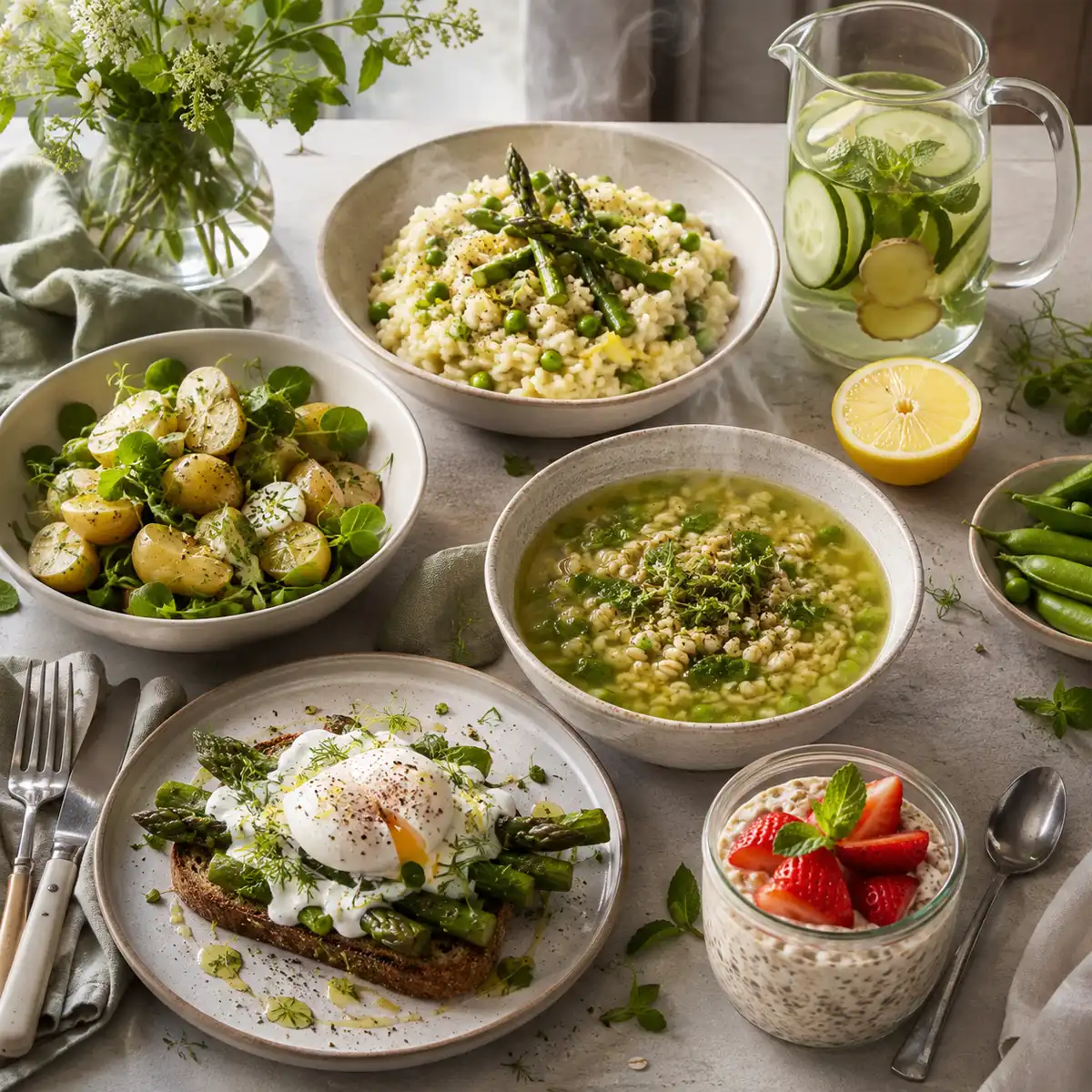
Spring risotto with asparagus peas and lemon is the one to make on a Sunday evening when you want the kitchen to smell like something good. Preparation time is 10 minutes, cook time is 25 minutes, total time is 35 minutes, and it yields 2 generous portions. Bring 800ml of low-salt vegetable stock to a gentle simmer. In a wide pan, heat 2 tablespoons extra virgin olive oil and soften 1 finely chopped small onion and 2 chopped garlic cloves for 4 minutes. Add 160g arborio or carnaroli risotto rice and stir for 1 minute. Add a ladle of warm stock and stir until absorbed, continuing one ladle at a time for 18 minutes. In the final 5 minutes, add 200g trimmed British asparagus cut into 3 cm pieces and 150g frozen peas. Finish with the zest and juice of half a lemon, 30g grated Parmesan (or a hard-vegetarian alternative), and a handful of torn mint leaves.
Nutritional highlight. Asparagus contributes inulin, a prebiotic fibre that feeds short-chain fatty acid-producing gut bacteria. Peas deliver around 8g of plant protein per portion and meaningful vitamin K. Lemon zest carries the polyphenols concentrated in the peel rather than the juice. Vegetarian, gluten-free (confirm the stock). For a dairy-free version, replace the Parmesan with 2 tablespoons of nutritional yeast and a splash of olive oil.
Warm Jersey Royal salad with watercress and mustard dressing
Warm Jersey Royal salad with watercress is the recipe to make when the evenings are bright but the air is still cool. Preparation time is 5 minutes, cook time is 18 minutes, total time is 23 minutes, and it yields 2 portions. Scrub 500g of Jersey Royals (do not peel; the skin is where much of the nutrition sits), and simmer in well-salted water for 15 to 18 minutes until tender. Drain and halve. Whisk together 3 tablespoons extra virgin olive oil, 1 tablespoon wholegrain mustard, 1 tablespoon cider vinegar, half a teaspoon of clear honey, and a grind of black pepper. Toss the warm potatoes through the dressing, add 2 large handfuls of watercress, 1 finely sliced spring onion, and a small handful of chopped fresh dill.
Nutritional highlight. Jersey Royals supply more vitamin C than most maincrop potatoes, partly because they are eaten young and cooked with their thin skins on. Watercress is one of the most nutrient-dense greens available in the UK, delivering vitamin K, folate, glucosinolates, and a striking peppery bitterness that earns it the name of a traditional spring tonic. Naturally gluten-free and dairy-free. For a vegan version, swap the honey for maple syrup. To make it a complete meal, add a 100g tin of drained tuna or a soft-boiled egg per person.
Fun fact: Watercress was the first cultivated crop in Britain after the Romans introduced it, and a 2023 review in the journal Foods noted watercress as the single most nutrient-dense of 47 vegetables measured, scoring 100 on an index based on 17 key nutrients per calorie.
Spring green broth with leek pea shoots and barley
Spring green broth is the recipe for the evening when you want a bowl rather than a plate. Preparation time is 8 minutes, cook time is 22 minutes, total time is 30 minutes, and it yields 2 bowls. In a deep pan, heat 1 tablespoon olive oil and soften 1 sliced leek (white and pale green parts) for 5 minutes. Add 80g pearl barley (pre-rinsed) and 900ml warm vegetable stock. Simmer for 18 minutes until the barley is tender. Add 150g shredded spring greens (or cavolo nero), 100g frozen peas, and the juice of half a lemon, and cook for 2 more minutes. Serve topped with a generous handful of pea shoots and a swirl of olive oil.
Nutritional highlight. Pearl barley provides beta-glucan, a soluble fibre with RCT evidence for modest LDL cholesterol reductions when eaten regularly, as reflected in the European Food Safety Authority health claim. Leeks contribute prebiotic fructans and kaempferol, a flavonoid studied for vascular health. Spring greens and pea shoots together deliver folate, vitamin K, and chlorophyll. Vegan and dairy-free. For a gluten-free version, replace the pearl barley with 100g pre-cooked quinoa and reduce the stock to 700ml.
Asparagus and poached egg on rye with a yoghurt dressing
Asparagus and poached egg on rye is the spring brunch or light supper that reads elegant and takes 15 minutes. Preparation time is 5 minutes, cook time is 10 minutes, total time is 15 minutes, and it yields 2 portions. Trim 200g British asparagus, toss in 1 teaspoon olive oil and a pinch of salt, and roast at 220°C for 8 to 10 minutes until tender with a slight char. Meanwhile, poach 2 large eggs in gently simmering water with a splash of vinegar for 3 minutes. Mix 4 tablespoons natural yoghurt with 1 crushed garlic clove, 1 tablespoon lemon juice, and a pinch of salt. Toast 2 slices of rye bread, spread with the yoghurt dressing, top with the roasted asparagus, add a poached egg per slice, and finish with a crack of black pepper and a sprinkle of chilli flakes if you like heat.
Nutritional highlight. Eggs provide roughly 6g complete protein per egg plus choline, a nutrient important for liver function that most UK adults under-consume according to 2024 British Nutrition Foundation data. Rye bread delivers arabinoxylan, a fermentable fibre linked in a 2022 Nutrients review to improved post-meal glucose response. Natural yoghurt contributes live cultures that contribute to overall gut microbiome diversity. Vegetarian. For a gluten-free version, swap the rye for a certified gluten-free seeded loaf. For a dairy-free version, replace the yoghurt dressing with a tahini and lemon blend.
Overnight oats with British strawberries and mint
Overnight oats with strawberries and mint is the breakfast that bridges the detox recipe collection into the week that follows. Preparation time is 5 minutes the night before, no cook time, total time is 5 minutes active, and it yields 2 portions. Mix 80g rolled oats with 200ml kefir or natural yoghurt, 1 tablespoon chia seeds, 1 tablespoon ground linseeds, and a splash of oat milk. Refrigerate overnight. In the morning, top each portion with 100g sliced British strawberries (in season May to early July, or use frozen the rest of the year), a handful of torn mint leaves, and a drizzle of honey if you want it.
Nutritional highlight. Oats deliver 4g of beta-glucan per portion, the soluble fibre with the strongest cholesterol-reduction evidence. Kefir contributes around 10 live bacterial strains, and a 2022 RCT published in Cell from the Sonnenburg lab at Stanford reported that diets rich in fermented foods increased microbiome diversity and reduced 19 inflammatory markers across 10 weeks. Linseeds supply plant-form omega-3 (ALA) and lignans. Strawberries contribute ellagic acid and anthocyanins. Vegetarian. For a dairy-free version, use coconut yoghurt or a plant-based kefir alternative.
How to use these recipes over a gentle spring week
A realistic rotation, not a prescription. Monday evening: The Jersey Royal salad, quick and bright. Tuesday: the asparagus risotto if you have 35 minutes, or the asparagus poached egg on rye if you have 15. Thursday: the green broth, which reheats well for Friday's lunch. Saturday brunch: the poached egg recipe again if you enjoyed it, or shift it to Sunday. Overnight oats run as a breakfast companion three mornings of the week. Across seven days, this rotation delivers five to seven daily vegetable servings, twice-weekly legumes or whole grains, and a consistent olive oil base.
The goal is not perfection. It is closing the gap between what you already know about eating well and what actually ends up on the plate on a Tuesday evening. Speak to a registered dietitian if you want to adapt this to a specific clinical situation.
A week of spring eating that asks nothing extreme of you
Start with the Jersey Royal salad on Monday. It is the recipe that takes the least kitchen commitment and demonstrates what spring eating actually tastes like. Add the asparagus risotto for a quiet Sunday. Batch the green broth for a Thursday bowl that turns into Friday lunch. Keep a jar of overnight oats in the fridge so the first meal of the day is already made before you open your eyes. Across one week, these spring detox recipes UK shoppers will actually cook give you watercress, asparagus, Jersey Royals, spring greens, peas, and British strawberries in regular rotation, with no supplements, no juice days, and no theatre. That is how gentle seasonal resets are meant to work. Consistency at the produce level, flexibility at the meal level.
detox water recipes UK with cucumber mint and ginger and kimchi recipe UK with British cabbage and our existing 7-day detox meal plan using British supermarket staples