
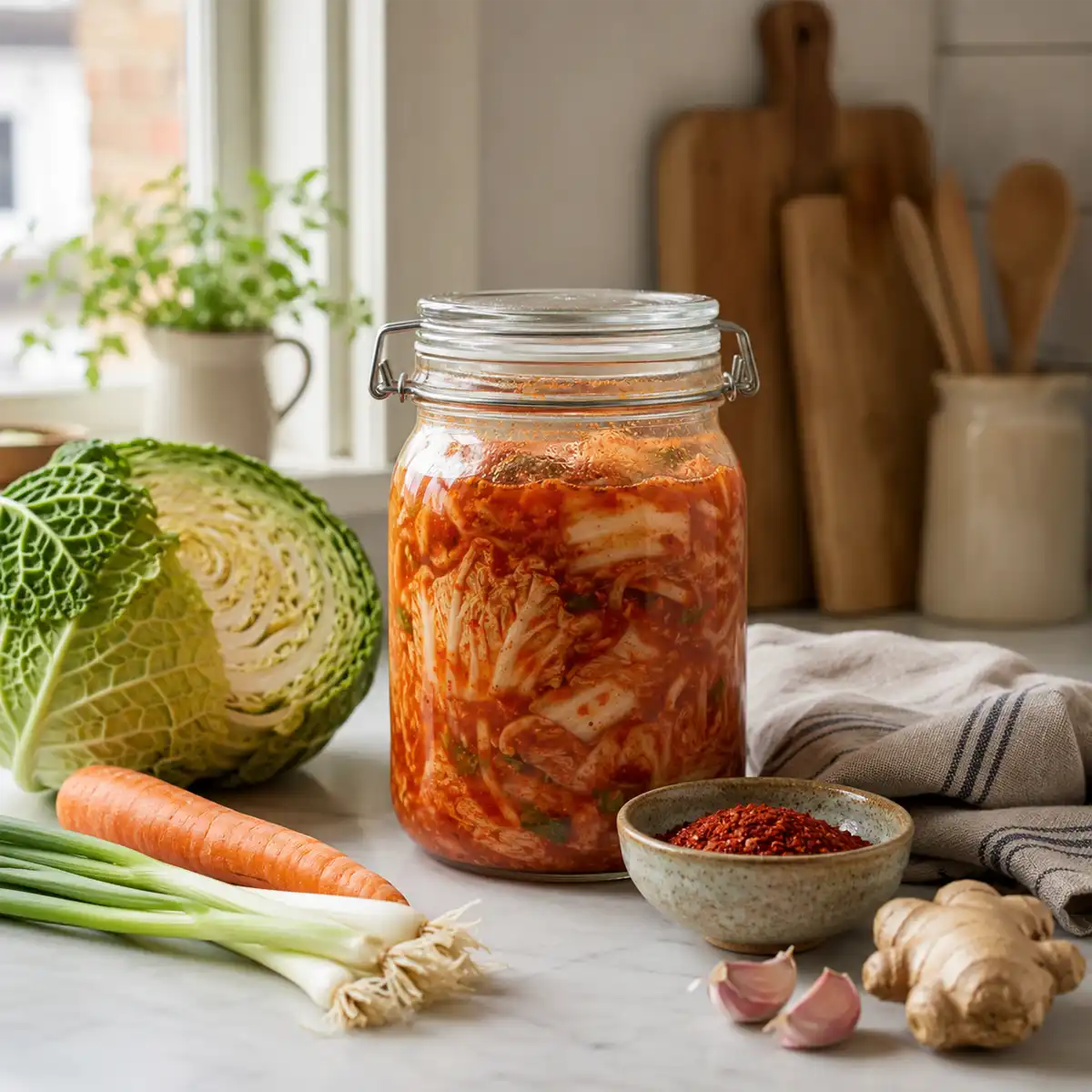
A glass jar of fermenting cabbage on the kitchen worktop smells like promise by day three. By day five, when the bubbles start rising through the brine and the colour deepens from salmon pink to deep red-orange, you know something is working. The thing nobody tells you about fermenting your own kimchi in the UK is that it is stubbornly forgiving. You do not need napa cabbage. You do not need a specialist Korean grocer. This kimchi recipe UK cooks will actually finish uses British savoy or January King, gochugaru ordered online or found in most large supermarkets, and a handful of ingredients from the everyday aisle.
Kimchi is a traditional Korean fermented vegetable preparation, typically built around cabbage, salt, chilli, garlic, ginger, and seafood paste, left to ferment at room temperature for 3 to 7 days before being moved to the fridge. It earned it place in the wellness conversation because fermented foods have moved from folk food to clinical evidence in the past decade. A 2022 RCT published in Cell from the Sonnenburg laboratory at Stanford demonstrated that a diet rich in fermented foods increased microbiome diversity and reduced 19 inflammatory proteins across 10 weeks, compared with a high-fibre diet alone. The 2024 RCT in Gut extended these findings in UK populations.
Home-fermented food also carries a small but real food-safety consideration, which is the reason UK Food Standards Agency guidance on home fermentation is worth reading before you start. Use clean equipment, weigh salt accurately (not by eye), keep ferments below 23°C, and discard any jar with mould, discolouration, or an off smell. If you are pregnant, immunocompromised, or managing a gut condition, speak to your GP or a registered dietitian before adding home-fermented foods to your routine; commercial options may be the better starting point.
What kimchi is and why it works with British cabbage
Traditional Korean kimchi uses napa cabbage (baechu), a long pale-green cabbage that holds its texture well under long fermentation. Napa is sold in larger UK Tesco and Sainsbury's branches and online, but it is not consistently available at neighbourhood shops. British alternatives work extremely well. Savoy cabbage offers a similar structural crunch with a slightly more assertive flavour. January King, available at British greengrocers roughly November to February, has beautiful blue-green outer leaves and ferments to a particularly rich colour. A firm white cabbage will also work, though the final texture is slightly softer.
Gochugaru, the coarse-ground Korean chilli that gives kimchi its signature colour and medium heat, is the ingredient worth sourcing properly. Tesco and Sainsbury's Taste the Difference stock Korean gochugaru in the world foods aisle in most larger stores. Online, Sous-chef and Amazon UK both stock authentic Korean gochugaru for £6 to £10 per 150g. Crushed chilli flakes from the general supermarket spice aisle are not a direct substitute because they tend to be hotter and finer-ground, but at a pinch you can use half the weight of crushed chilli flakes plus a teaspoon of sweet paprika for colour.
The recipe itself with prep cook and fermentation times
Classic cabbage kimchi with British savoy takes 30 minutes of active prep, 2 hours of salting, and 3 to 7 days of room-temperature fermentation, and it yields approximately 1.5 litres (enough for 20 to 30 servings of 2 to 3 tablespoons each). You will need one 1.5-litre wide-mouth glass jar (Kilner jars work well) with a lid that can release gas, a large mixing bowl, and clean hands or food-safe gloves.
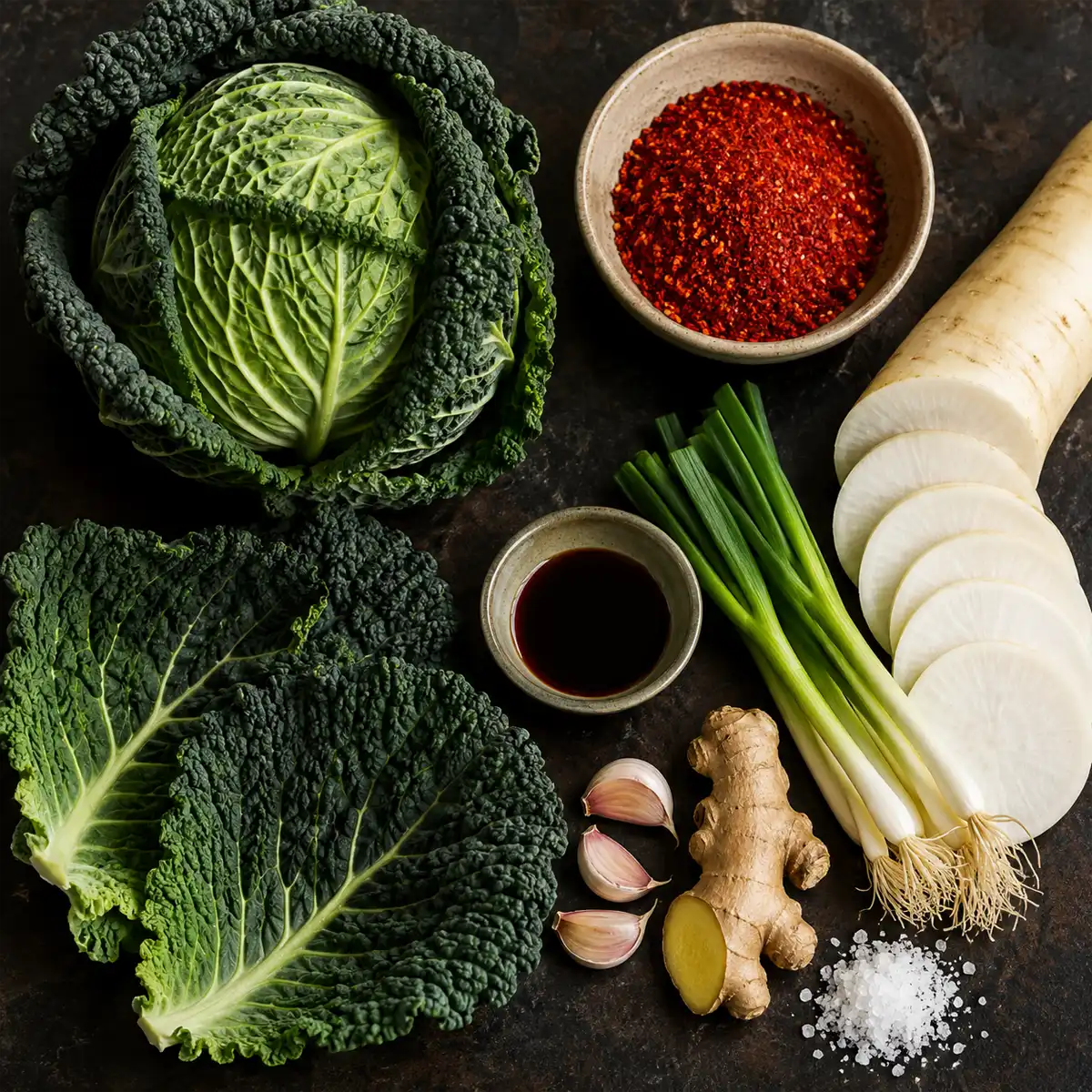
Ingredients. One medium savoy cabbage (approximately 1 kg), 50g fine sea salt (not rock salt, which takes too long to dissolve), 4 garlic cloves, 2 cm piece of fresh ginger, 2 spring onions, 1 medium carrot, 1 small daikon radish or half a large British mooli (substitute regular radish or turnip if unavailable), 3 tablespoons (about 30g) gochugaru, 1 tablespoon fish sauce (or 2 tablespoons soy sauce for a vegan version), 1 teaspoon honey or maple syrup, 2 tablespoons filtered water.
Method. Quarter the cabbage lengthways through the core, then slice crossways into 3 cm pieces, discarding the tough core. Place in a large bowl, sprinkle with the 50g sea salt, and toss thoroughly. Cover with a plate weighted down with a tin or a water-filled jar. Leave for 2 hours, turning every 30 minutes, until the cabbage has released liquid and the leaves feel pliable but still crunch.
While the cabbage salts, make the paste. In a small blender or with a fine grater, combine the garlic, ginger, 2 tablespoons of water, honey, fish sauce (or soy), and gochugaru into a thick red paste. Finely slice the spring onions, julienne the carrot and the daikon (or substitute). After 2 hours, rinse the cabbage thoroughly in 2 changes of cold water (do not skip this, or the kimchi will be inedibly salty), drain well, and squeeze out the excess water.
Combine the cabbage, vegetables, and paste in a large bowl. Wearing food-safe gloves, massage the paste thoroughly through the cabbage until every piece is coated. Pack tightly into the glass jar, pressing down with a clean spoon until the brine rises above the vegetables. Leave at least 3 cm of headroom at the top because fermentation will produce bubbles and the volume will rise. Seal loosely and set on a saucer at room temperature (ideally 18 to 22°C) out of direct sunlight.
What to expect during 3 to 7 days of room-temperature fermentation
Day 1: the colour is bright and the mixture looks raw. Day 2 or 3: you will see small bubbles forming around the cabbage pieces, and the brine begins to look slightly cloudy. This is lactic acid bacteria doing exactly what you want them to do. Taste a small piece on day 3. If it has a mild sour tang and a slight fizz on the tongue, you are on track. If it still tastes mostly of salt and chilli with no sourness, give it another day. Most UK kitchens, where room temperature sits around 20°C, take 4 to 5 days to reach the right flavour.
Day 5 to 7: the kimchi should have a pleasant sourness, a complex umami depth, and a slight effervescence when you dig in. At this point move it to the fridge, where fermentation continues more slowly and the flavour develops over the following 2 to 3 weeks. Kimchi keeps well for around 3 months in the fridge, though the texture softens and the flavour deepens the longer it sits. If at any point you see visible surface mould (fuzzy, grey, green, or black), discard the whole jar. This is rare if the brine stays above the cabbage, which is why packing it down matters.
Fun fact: A 2024 trial published in the journal Gut found that adults eating six servings of fermented foods a week including kimchi across 10 weeks showed increased microbiome diversity and measurable reductions in several systemic inflammatory markers.
What a spoonful of homemade kimchi actually delivers
Each 30g serving of finished kimchi contributes roughly 15 calories, 1g of protein, 2g of fibre, and measurable amounts of vitamin K, vitamin C, and folate. The more relevant nutritional story is the live lactic acid bacteria: fermented kimchi typically contains Lactobacillus sakei, Lactobacillus plantarum, and Leuconostoc species, which deliver the live microbial content that associates kimchi with the gut-microbiome benefits observed in fermented-food trials. Heat kills these bacteria, so eating kimchi raw (as a side, in a salad, on rice, or alongside eggs) preserves the benefit. Cooking it into stews or stir-fries removes the probiotic component but retains the flavour complexity and fibre.
A cautionary note on sodium. Home kimchi averages around 250mg sodium per 30g serving, similar to a small pinch of salt. The UK Eatwell recommendation is no more than 6g of salt per day (about 2.4g sodium). Three servings of kimchi a day would contribute 750mg sodium, which is noticeable but manageable within normal intake. People on low-sodium diets for blood pressure or kidney reasons should use kimchi sparingly and discuss regular consumption with their GP or a registered dietitian.
How to work homemade kimchi into UK weeknight meals
Kimchi earns its place by adding flavour rather than by being the main event. Start with 2 tablespoons at breakfast alongside a fried egg on rye toast. Add it to the lentil and beetroot bowl as a brightness layer. Stir a tablespoon through cooked rice before serving a chicken traybake. Fold it into cream cheese for a sharp sandwich filling. A bowl of miso soup topped with a spoonful of kimchi is one of the simplest and most satisfying lunches in a British February, when most of the vegetables on offer are root-heavy and the kitchen needs something brighter.
If you want to cook with it, kimchi fried rice (kimchi bokkeumbap) is the entry point. Heat a teaspoon of sesame oil in a pan, add 150g of chopped kimchi and 2 chopped spring onions, stir for 2 minutes, add 200g cold cooked rice, stir-fry until everything is coated, crack an egg into a well in the centre, and serve with a sprinkle of toasted sesame seeds and nori. Fifteen minutes, one pan, and a lesson in how fermentation rewards patience with flavour.
From jar on the worktop to regular fridge staple
Start the kimchi on a Sunday morning. You will have 30 minutes of active prep and 2 hours of salting, most of which happens while you get on with something else. By Thursday evening, the jar will be ready to move to the fridge. By the following Sunday, you have a finished kimchi recipe UK that costs roughly £3.50 to produce versus the £4 to £6 for a 300g jar at Tesco. It keeps for 3 months. It transforms scrambled eggs, rice bowls, miso soup, and weekend sandwiches without any further work from you. Most importantly, it is the easiest introduction to home fermentation a UK kitchen can offer, and it builds the foundation for exploring sauerkraut, water kefir, and milk kefir if you get curious later. Speak to your GP or registered dietitian before adding home-fermented foods to your routine if you have a gut condition or are pregnant.